






THE BRIGHTEST HEROINE
“I have always said that birth is love in reverse.”
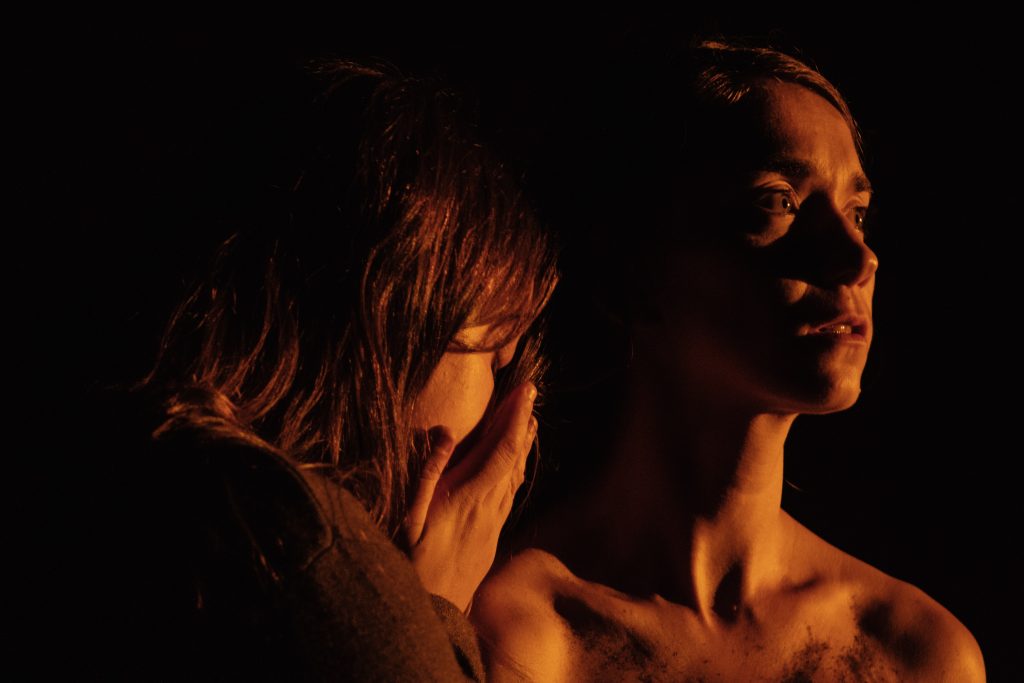
Drawing inspiration from personal experiences, Banushi creates an unholy shrine to the mother-child relationship. To celebrate it. To exorcise it. To fill it with vows and curses. To fall in love with it. For, as he himself notes, “I have always said that birth is love in reverse.”
The stage becomes a landscape of memory. As eerie as it is familiar. The performers, immersed in silence, create moments of profound emotion and urge us to recognize and confront our own memories, our own relationships, and the emotional legacy we carry.
This breakout director’s new creation is a visual poem about the mother-child relationship. A show that is a tribute to the women who nurtured us.
Director’s note
“When I was about a year old, my mother had to leave me with my grandmother in Albania and go away. Until I was thirteen, I called my grandmother ‘mami.’ When my mother took me with her to Athens, I grew up in the apartment above the bakery where she worked, with the smell of freshly baked bread. I grew up around many women. I grew up around young women and old women. I grew up with more than one mother. This show is for them: a wish, a prayer to the weight the word ‘mom’ carries for both the one who hears it and the one who says it. Who takes care of whom—I never understood this complicated relationship. And I never will. But I’m trying to unravel it like an umbilical cord, like the viscera that connects life to its roots.” -Mario Banushi
The old world is dying and the new struggles to be born. It’s the time of the monsters.
“The Brightest Heroine” (title tbc), Panos Malactos’ new solo, stages a physical attempt to fight the monsters of the present. A choreographic exploration of a body that reacts, mobilizes and revolts.
The work unfolds as a stamina test. The body becomes a site of political action. Charged with the force of collective uprising, it traces the emotional and kinetic trajectory of resistance, exhaustion and reboot.
The heroine is in the final level of the game, where she confronts the final boss. But in a world where spells operate without visible sorcerers behind them, who is the enemy? Is there a decisive move that could end the battle? Or is the battle designed to never end?
The audience is invited into a space where the boundaries between digital and physical reality blur, where the battle and its aftermath coexist, and where perseverance appears as a fragile gesture in a world that increasingly seems to be trolling us.
Conceived and Directed by Mario Banushi
Cast Vasiliki Driva, Dimitris Lagos, Eftychia Stefanou / Ilia Koukouzeli, Angeliki Stellatou, Fotis Stratigos, and Panagiota Υiagli
Set & Costume Design Sotiris Melanos
Original Music & Sound Design Jeph Vanger
Lighting Design and Associate Dramaturg Stephanos Droussiotis
Artistic Collaborators Aimilios Arapoglou, Thanasis Deligiannis
Assistant Director Theodora Patiti
International Relations & Tour Management Nikos Mavrakis
Production Management Christos Christopoulos – TooFarEast
Auditions & Residency Coordinator Konstantina Douka Gkosi – TooFarEast
In collaboration with OMAZ civic non-profit company
Commissioned and Produced by Onassis Stegi
Co-produced by FOG Festival / Triennale Milano [IT], Noorderzon Festival / Grand Theatre Groningen [NL] & more to be announced soon
Initial research & development were made possible with the support of the Onassis AiR Dramaturgy Fellowship [GR] and the Centre Culturel Hellénique—Paris [FR]
Supported by the Onassis Stegi “Outward Turn” Cultural Export Program.
With the financial support of the Ministry of Culture

The old world is dying and the new struggles to be born. It’s the time of the monsters. “The Brightest Heroine” (title tbc), Panos Malactos’ new solo, stages a physical attempt to fight the monsters of the present. A choreographic exploration of a body that reacts, mobilizes and revolts.
The work unfolds as a stamina test. The body becomes a site of political action. Charged with the force of collective uprising, it traces the emotional and kinetic trajectory of resistance, exhaustion and reboot.
The heroine is in the final level of the game, where she confronts the final boss. But in a world where spells operate without visible sorcerers behind them, who is the enemy? Is there a decisive move that could end the battle? Or is the battle designed to never end?
The audience is invited into a space where the boundaries between digital and physical reality blur, where the battle and its aftermath coexist, and where perseverance appears as a fragile gesture in a world that increasingly seems to be trolling us.